Health forms and medications
Colorado licenses Camp Alexander as a child care facility, so we collect more paperwork than most Scout camps. This page walks you through every form and signature, and how medications work once you get to camp.
On this page: What you need Step by step Who signs what Common mistakes Medications at camp Staying healthy
Four steps to finished health forms
1
Fill in your parts first
Print the packet and complete everything a parent or guardian fills in and signs, up to the sections the health care provider completes.
2
Bring the packet to the physical
Your provider completes and signs Part C, plus the immunization form and any medication pages. Bring the whole packet so it only takes one visit.
3
Upload everything to CampDoc
New to CampDoc? You’ll get an invitation at the email entered at registration. Already have an account? Just log in. Upload every page there, clear and complete.
4
Due 14 days before camp
Every form for every youth and adult has to be in CampDoc at least 14 days before your week starts. Scouts without complete, signed forms can’t attend.
Find your list
Youth have the most paperwork because of Colorado’s child care rules. The medication forms only apply if your Scout takes or carries medication at camp.
Every Scout (youth)
- BSA Annual Health and Medical Record, Parts A, B1, B2, and C
- Colorado Certificate of Immunization
- Copy of the health insurance card, front and back
- Colorado Addendum: Additional Information and Sunscreen Permission
- Only if your Scout takes or carries medication at camp (including a rescue inhaler or EpiPen): a Permission for Medication Administration form for each medication, plus the Medication Log for any medication the Med Lodge gives
- Only if your Scout carries a rescue inhaler or EpiPen: the Colorado Addendum Contract to Carry, on top of that medication’s Permission for Medication Administration form
Every adult
- BSA Annual Health and Medical Record, Parts A, B1, B2, and C
- Copy of the health insurance card, front and back
- Adult Reference Form: your signed form plus three character references
- Adults keep their own medications in locked storage in their campsite and don’t need medication forms
The whole unit
- Adult Reference Forms for every adult, in alphabetical order by last name
- YPT Aging Report from my.scouting, showing each adult’s registration and Safeguarding Youth training
- Swim Classification Records, with a copy of the tester’s current certification, if your unit did swim tests at home
Completing your Scout’s forms
Start at least six weeks before your week so there is time to book a physical and fix anything we flag.
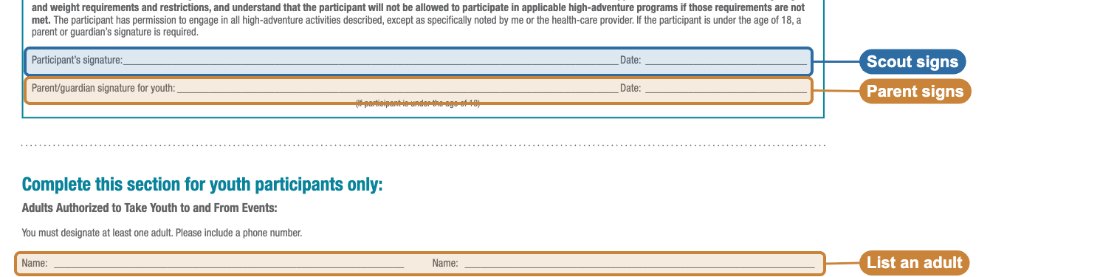
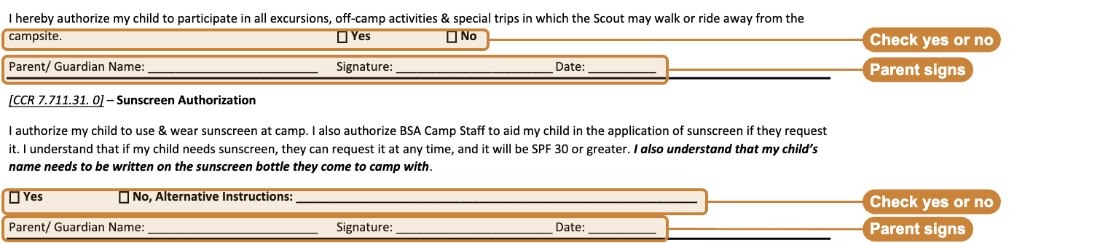
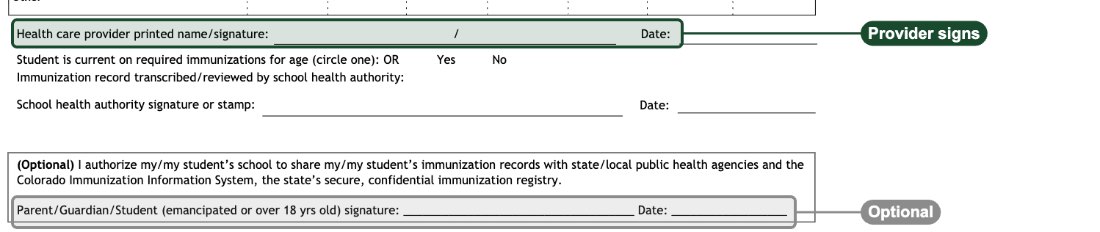
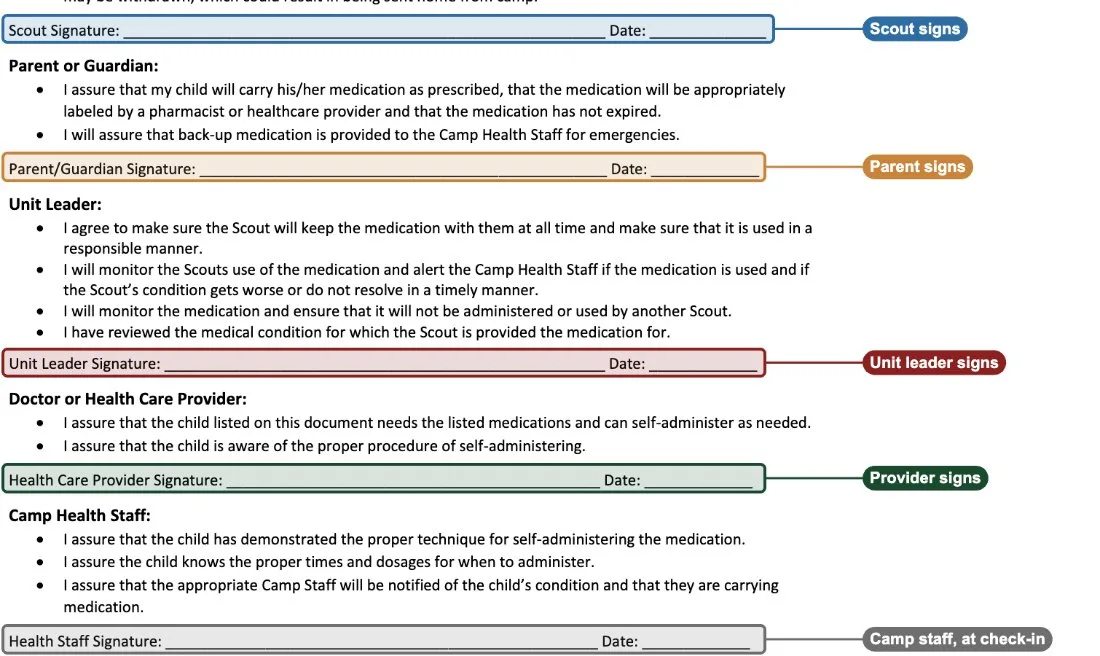
In the pictures below, colors show who signs: Parent or guardian Health care provider Scout Unit leader Camp health staff
1
Print the youth packet and fill in your parts
Before the doctor visit, fill in everything that’s yours:
- Part A: sign as the parent or guardian, have your Scout sign, and list at least one adult allowed to take your Scout to and from events.
- Part B1: health history, insurance, and emergency contacts.
- Part B2: list every medication, including over-the-counter ones, check yes or no for over-the-counter medicine, and sign. You sign B2 even if your Scout takes no medication.
- Colorado Addendum, Additional Information: fill in every field and sign both the excursion permission and the sunscreen permission.

2
Take the packet to the physical
The health care provider has to be an MD, DO, nurse practitioner, or physician assistant. Colorado doesn’t accept signatures from chiropractors or podiatrists. At the visit, the provider:
- Completes and signs Part C, the physical.
- Signs Part B2 if your Scout takes any medication.
- Fills in and signs the Colorado Certificate of Immunization. Out of state, any one of these works instead:
- Letterhead report: the office prints the full immunization report on office letterhead and signs it.
- Stamped report: the office prints the report on plain paper, stamps the office information on the first page, and signs it.
- Colorado form, transcribed: the office copies the dates onto the Colorado form and signs it. Upload both the Colorado form and the original record.
- Signs a Permission for Medication Administration form for each medication your Scout will take or carry at camp, including a rescue inhaler or EpiPen.
- Also signs the Contract to Carry if your Scout carries a rescue inhaler or EpiPen.
The physical must be within 12 months of your Scout’s arrival at camp.


3
Finish the medication forms
Only if your Scout takes or carries medication at camp:
- Sign the parent section of each Permission for Medication Administration form. One form covers one medication.
- Fill in the top of the Medication Log for each medication the Med Lodge will give. A carried inhaler or EpiPen doesn’t need one.
- A rescue inhaler or EpiPen needs both forms: its own Permission for Medication Administration form and the Contract to Carry. The Contract to Carry also needs your Scout’s and your unit leader’s signatures. Camp health staff sign the last line at check-in.

4
Set up or log in to CampDoc
Already have a CampDoc account? You won’t get an invitation. As long as your unit registered your Scout with the email you already use in CampDoc, just log in at app.campdoc.com and this year’s registration will be there. Don’t make a second account. If your family uses CampDoc from another camp, give your unit that same email before they register.
New to CampDoc? CampDoc emails an invitation within a few days after your unit registers and enters your Scout’s information. It comes from Pathway to the Rockies via CampDoc (noreply@campdoc.com) and goes to the email entered at registration, so use a parent or guardian email, not your Scout’s, and check your spam folder. Select Accept Invite and create a password. (CampDoc’s sign-up help walks through it too.)
Our CampDoc setup page walks through each case, including what to do if you used a different email before.
5
Upload everything to CampDoc
Scan or photograph every page, flat and in good light, so every signature and date is readable. Upload the insurance card front and back. CampDoc takes PDF, JPG, GIF, or PNG files up to 5 MB that aren’t password protected (CampDoc’s upload help). Have everything in at least 14 days before your week. Our team reviews each file and will reach out if something needs fixing.
6
Pack medications the right way
Prescription medications come to camp in the original pharmacy container, labeled with your Scout’s name, the date, the doctor’s name and phone number, and the dosage. Ask your pharmacy for a “summer camp bottle” if you need one. Colorado doesn’t allow daily pill organizers. Send only enough for the week, and don’t send over-the-counter medicine, since the Med Lodge has it. See how medications work at camp.
Who signs what
Missing signatures are the most common reason forms get sent back. Check this list before you upload.
Form
Who signs
Required for
BSA Part A
Parent or guardian, and the Scout. Adults sign their own.
Every youth and adult camper
BSA Part B1
No signature. Complete every field.
Every youth and adult camper
BSA Part B2
Youth: parent or guardian always. Health care provider too if any medication is listed. Adults: no signature.
Every youth and adult camper
BSA Part C
MD, DO, nurse practitioner, or physician assistant
Every youth and adult camper
Colorado Certificate of Immunization
Health care provider. Out of state, a signed report on office letterhead or a signed, office-stamped printout works instead.
Every Scout (youth camper)
Colorado Addendum: Additional Information
Parent or guardian, twice: excursions and sunscreen
Every Scout (youth camper)
Permission for Medication Administration
Parent or guardian, and the prescribing health care provider. One form per medication.
Scouts taking or carrying any medication at camp, including a rescue inhaler or EpiPen
Contract to Carry
Scout, parent or guardian, unit leader, and health care provider. Camp health staff sign at check-in.
Scouts carrying a rescue inhaler or EpiPen (they also need a Permission for Medication Administration form for it)
Adult Reference Form
The adult leader, plus three character references
Every adult camper staying overnight
Double-check before you upload
The mistakes that most often send forms back to families, so you only do them once.
These are the problems that most often send forms back to families. Catch them before you upload and you won’t have to redo anything.
Common mistakes we see
- No parent signature on Part B2 because the Scout takes no medication. It’s still required.
- Part C signed by a chiropractor or podiatrist.
- An immunization form that only says “see attached.”
- One medication form covering several medications.
- A Contract to Carry with no Permission for Medication Administration form for the same inhaler or EpiPen.
- Only the front of the insurance card.
- A physical more than 12 months old by the time camp starts.
- The Scout’s email in the registration instead of a parent’s, so the CampDoc invitation never arrives.
Medications at camp
Colorado’s child care rules set how youth medications come to camp, get checked in, and are given out. Here’s how it works from packing to pickup.
Before camp
- Prescription medicine comes in the original pharmacy bottle, labeled with the Scout’s name, the date, the doctor’s name and phone number, and the dosage. Ask your pharmacy for a “summer camp bottle” if you need one.
- No daily pill organizers, and don’t cover any part of the label. Medicine in pill organizers or unlabeled containers is disposed of.
- Send only enough for the week.
- Leave over-the-counter medicine like Tylenol and ibuprofen at home. The Med Lodge has it.
- Vitamins and supplements need a letter from an MD, DO, PA, or nurse practitioner listing the camper, the supplement, the dose, and the times. Without it, they stay locked up until you leave.
- Fill in the top of the Medication Log for each medication.
Sunday check-in
- Your Troop Guide gives your unit a time to meet with the Med Lodge.
- Send the two adult leaders who manage your unit’s paperwork and medications.
- Every youth medication is checked in, including vitamins, supplements, and anything over the counter.
- Med Lodge staff validate each camper’s forms and medications, go over the routine for the week, and answer your questions.
- Outback participants check in at the Med Lodge too.
- A Scout who needs ongoing care, like wound care, brings a note from a doctor or parent with instructions, plus the sterile supplies. Our medical staff can’t give injections. Diabetes, seizures, or other daily or complex medical care? Contact the camp administrators before camp at 719-219-2916 or camp.alexander@scouting.org, so the Med Lodge can plan with you.
During the week
- Only trained staff give medication. Leaders and parents can’t give any medication, vitamin, or supplement to a Scout.
- Summer Camp: the medical staff set medication times, listed in the Hip Pocket Handbook. Unit leaders make sure Scouts take their medication, and two adult leaders walk Scouts to the Med Lodge, ideally everyone at the same time.
- Outback: after check-in, trained Outback staff hold participants’ medications and handle every med pass, on the trail and at camp.
- Rescue inhalers, EpiPens, and anaphylaxis kits are the only medications a Scout keeps, and only when both a signed Contract to Carry and a Permission for Medication Administration form are in CampDoc.
- If a Scout uses their EpiPen, or their inhaler isn’t settling an asthma attack, the Scout, their buddy, or a unit leader tells the nearest staff member right away, and staff get word to the Med Lodge. Every EpiPen use gets reported, even if the Scout seems fine afterward: using an EpiPen means a trip to the ER, and the Med Lodge coordinates it. Everyday inhaler use doesn’t need to be reported.
- Need a dose outside the scheduled times? Set it up with the medical staff ahead of time.
Going home
- Before you leave Saturday, unit leaders pick up every Scout’s medications, vitamins, and supplements from the Med Lodge.
- Anything left behind is disposed of after one week.
- Adults keep their own medications in locked storage at their campsite all week and don’t check them in.
Staying healthy at camp
Getting ready for the altitude, and how illness, injuries, and emergencies are handled.
Get ready for the altitude
Camp sits at 8,200 feet, and Outback climbs to 14,115 feet on Pikes Peak. Staying hydrated is the best way to prevent altitude sickness.
- A month before camp: work up to about 4 liters of water a day, so drinking that much feels normal by the time you arrive.
- At camp: drink at least 4 liters by 4 p.m. and 6 liters by 8 p.m., every day.
- Spread it out through the day instead of chugging, and mix in a sports drink or salty snacks to replace electrolytes.
- Cut back on sugary and carbonated drinks.
- Carry a refillable water bottle everywhere.
- Headache, nausea, dizziness, or unusual tiredness can mean altitude sickness. Tell your leader and visit the Med Lodge.
Illness
If your Scout is sick, keep them home. At camp, we call a parent or guardian to pick up a camper who has:
- A fever of 100.4°F or higher for more than 24 hours
- Vomiting for more than 24 hours
- Diarrhea three times in 24 hours
- Unexplained extreme fatigue or muscle aches for more than 8 hours
- Two or more symptoms at the same time
We also call home for an unexplained rash, cough, or sore throat lasting more than 24 hours, or if a camper needs emergency care or a trip to the hospital.
Injuries and emergencies
- The Med Lodge is staffed 24 hours a day by qualified medical staff who meet Scouting America’s camp accreditation standards (NCAP) and Colorado’s child care licensing rules.
- The nearest hospital, with a 24-hour emergency room, is UCHealth Pikes Peak Regional Hospital in Woodland Park, about 45 minutes from camp.
- Local emergency medical services handle serious emergencies, and camp medical staff arrange emergency medical transport.
- For a serious injury, an adult brings the injured person to the Med Lodge if it’s safe. If it isn’t, the medical team comes to you.
- We call a parent or guardian about any serious illness or injury as soon as we can. If we can’t reach them, the unit leader makes decisions in their place, so make sure the contacts on the health form can be reached that week.
- Your unit drives anyone who needs non-emergency care off site. Safeguarding Youth guidelines must always be followed, for the trip and for everyone who stays in camp. Bring a copy of the health form and sign out at the Camp Office. The Med Lodge has directions to local clinics, and leaders from another unit can help keep two-deep leadership in your campsite.
Keeping your unit on track
For unit leaders: check CampDoc a few weeks out, and bring a paper copy of every camper’s forms.
As your unit’s group leader in CampDoc, you can see and upload forms for everyone in your unit. Check it a few weeks out and nudge any family that hasn’t finished.
The two adults who manage your unit’s paperwork and medications will meet with the Med Lodge on Sunday. Bring a paper copy of every camper’s forms, including the BSA Annual Health and Medical Record, and keep it with your leaders, not packed in the trailer. You’ll need it on the drive to and from camp if anyone needs medical care on the road. Having a physical copy available also helps if there’s a problem with anyone’s CampDoc profile when you arrive. If a camper needs care off property during the week, you can request a copy of their forms from the Med Lodge to take along.
Whole unit forms
- Adult Reference Forms, in alphabetical order by last name
- YPT Aging Report from my.scouting
- Swim Classification Records and the tester’s certification, if you swim-tested at home
Health and medication questions
Supplements, inhalers, waivers and more, for Summer Camp and Outback.
Showing 17 questions
Are there extra waivers for the outfitters?
Yes, some outfitters, like the rafting and climbing guides, may require their own waivers. The specific forms for 2027 haven’t been set yet. We will share them at leader meetings and email them to registered units.
Can my Scout bring vitamins or supplements?
Yes, but they’re handled like any other medication. Your Scout needs a letter from an MD, DO, physician assistant or nurse practitioner that lists the camper, the supplement, the dose and the times to take it. Your unit checks the supplements and the letter in with the Med Lodge on Sunday, along with the rest of your medications, and Med Lodge staff give your Scout each dose during the week. Leaders and parents can’t hand them out.
Without the letter, the Med Lodge can’t give them out. They stay locked up at the Med Lodge for the whole week, and you get them back when you leave.
For packing, the Medication Log and how Sunday check-in works, see Medications at camp.
Can my Scout carry an inhaler or EpiPen?
Yes, but it takes two signed forms in CampDoc: the Colorado Contract to Carry and a Permission for Medication Administration form for that inhaler or EpiPen. The health care provider and a parent or guardian sign the Permission for Medication Administration form. The Scout, a parent or guardian, the unit leader, and the provider sign the Contract to Carry before camp, and camp health staff sign it at check-in. Rescue inhalers, EpiPens, and anaphylaxis kits are the only medications a Scout keeps with them. If your Scout uses their EpiPen, or their inhaler isn’t settling an asthma attack, they, their buddy, or a unit leader should tell the nearest staff member right away so the Med Lodge can respond. Every EpiPen use gets reported, even if your Scout seems fine, because it means a trip to the ER. See the health forms guide.
Do adult leaders need Safeguarding Youth training?
Yes. Every adult camper needs current Safeguarding Youth training. Your unit uploads a Safeguarding Youth Aging Report from my.scouting showing each adult’s registration and training, along with the other unit forms. See the unit forms.
Source: Scouting America’s Scouting’s Barriers to Abuse in the Guide to Safe Scouting.
Do adults need to turn in their medications?
No. Adults (18 and older) are responsible for their own medications at camp and don’t need to fill out the Medication Administration Forms.
How do we request a special diet or food allergy accommodation?
Kandle Dining runs our dining hall. Before camp, fill out their Special Diet Request form, one for each person who needs an accommodation. We’ll add the link to the form here once it’s available, and it’s also in the Camp Guide as a link and QR code.
Send it in as early as you can so the kitchen can plan for your week. Kandle works out each special diet with you directly. Questions about it go to the Kandle team at nutrition@kandledining.com.
Nut allergies: the dining hall isn’t nut-free. A Scout with a severe allergy needs a Contract to Carry and a Permission for Medication Administration form for their EpiPen, and keeps the EpiPen with them at all times.
List any food allergies on the Scout’s health forms in CampDoc too, so the Med Lodge knows about them.
How fit do participants need to be?
Very. Summit day starts at the Crags Trailhead near 10,000 feet, climbs through Devil’s Playground to 14,115 feet, and covers about 14 miles round trip with 4,300 feet of elevation gain on a Class 2 trail (route details on 14ers.com). It’s one of five full days of program. Monday is an acclimatization day of hiking around camp and up Blue Mountain, but participants should train for months before they arrive, not just the week before. See what summit day takes. Talk with your health care provider about the hike and the altitude at the physical.
I haven’t received anything from CampDoc. What should I check?
If you already have a CampDoc account with the email your unit entered at registration, you won’t get an invitation. Just log in at app.campdoc.com. New to CampDoc? The invitation comes within a few days after your unit registers and enters your Scout’s information. Look for an email from Pathway to the Rockies via CampDoc, sent from noreply@campdoc.com, and check your spam or junk folder. Still nothing? Ask your unit leader to confirm your Scout has been added and that the registration has the correct parent or guardian email, not your Scout’s. For technical issues, click the ? in the upper right corner of the CampDoc screen to reach their help desk.
Is there electricity in the campsites? What about a CPAP?
Campsites don’t have electricity, and running extension cords from nearby buildings isn’t allowed. If you use a CPAP, bring one that runs on batteries. Camp has charging locations on the property.
We already have a CampDoc account from another camp. Do we start over?
No. Before your unit registers, give your unit leader the email you already use in CampDoc. You won’t get an invitation. Just log in at app.campdoc.com and your Scout’s registration will be there. Don’t create a second account. Review every section for this year and upload this year’s signed forms. See our CampDoc setup page.
We did a swim test with our unit. What do we need to upload?
Upload two items under Whole Unit forms in CampDoc:
- The signed Swim Classification Record
- A copy of the tester’s certification
The tester’s certification must be current as of the test date. Accepted certifications are:
- BSA Aquatics Instructor
- BSA Swimming and Water Rescue
- Lifeguard or swim instructor certification from the American Red Cross, YMCA, or Ellis & Associates
We’re from out of state. Do we have to use the Colorado immunization form?
No. You can use any of these three options:
- Letterhead report: Your doctor’s office prints a full immunization report on office letterhead and signs it.
- Stamped report: The office prints the report on plain paper, stamps the office information on the first page, and signs it.
- Colorado form: The office copies the dates onto the State of Colorado form and signs it. Turn in both the state form and the immunization record.
Forms that say “See Attached” can’t be accepted.
What health forms do Outback participants need?
The same forms as summer camp: the BSA Annual Health and Medical Record Parts A, B, and C, plus the Colorado forms for youth. Everything is uploaded to CampDoc at least 14 days before your week. Leaders also carry a paper copy of everyone’s forms on the drive to and from camp and on every trip away from camp during the week. See the Outback health forms guide.
What if the weather turns, or a Scout can’t make the summit?
Staff decide on the trail, based on the weather and the whole group’s safety. If storms are building, the group can’t keep a safe pace, or someone shows signs of altitude sickness, they’ll turn around, even close to the top. Lightning is a real danger above tree line, and the hike from the summit back along the ridge to tree line is long and exposed. Altitude sickness can affect anyone, even fit, well-prepared hikers, so training helps but can’t guarantee a summit. Every trip runs with an emergency action plan. Turning back is the right call when conditions demand it, not a failure.
When is all our camp paperwork due?
All paperwork for youth and adults has to be uploaded to CampDoc at least 14 days before your week starts. Because Colorado licenses youth camps as childcare facilities, our team reviews everything ahead of time, and Scouts without a complete, signed BSA Annual Health and Medical Record can’t be admitted.
Bring a paper copy of your unit’s paperwork anyway, and keep it with your leaders, not packed in the trailer. You’ll need it on the drive to and from camp if anyone needs medical care on the road. Having a physical copy available also helps if there’s a problem with anyone’s CampDoc profile when you arrive. The leaders who handle your forms and medications will meet with the Med Lodge on Sunday.
Who can sign Part C of the health form?
An MD, DO, nurse practitioner, or physician assistant. Colorado doesn’t accept signatures from chiropractors or podiatrists. The physical also has to be within 12 months of your Scout’s arrival at camp.
Why is there so much medical paperwork?
Colorado classifies all youth camps as childcare facilities, so we have to collect more paperwork than most Scouting America camps. What your Scout needs depends on their medications:
- No medications: Only the immunization paperwork may be different from other camps.
- Rescue medication (inhaler or EpiPen): Two extra forms, both signed by the doctor: the Colorado Contract to Carry and a Permission for Medication Administration form.
- Daily or regular medications: One extra form per medication, the Permission for Medication Administration, completed by the prescribing doctor.
All of these forms are in the youth forms packet (PDF). To keep it to one doctor visit, print the whole packet ahead of time and bring it with you. Adults use the adult forms packet (PDF). The health forms guide walks through every form and who signs it.
At camp, all youth medications are turned in at check-in. During the week, Scouts come to the Med Lodge at their med times with water to take their medications. Safeguarding Youth rules apply on the way there and back, and at least one unit leader has to be at the Med Lodge with them. The Med Lodge is staffed 24 hours a day by qualified medical staff who meet Scouting America’s camp accreditation standards (NCAP) and Colorado’s child care licensing rules. We’ll go into more detail during the online leader meetings.
No questions match. Try other words.
The illness policy and other camp rules are in the camp policies.
Still stuck? Email camp.alexander@scouting.org or call 719-219-2916. For CampDoc technical problems, use the help button (the question mark) at the top right of any CampDoc screen.